Invoice vs Receipt — Key Differences Every Freelancer and Business Owner Should Know
If you have ever confused an invoice with a receipt — or used them interchangeably — you are not alone. Most freelancers and small business owners understand that both documents relate to payment, but the key difference between them is fundamental to how you manage your finances, stay compliant with tax authorities, and maintain clean accounting records.
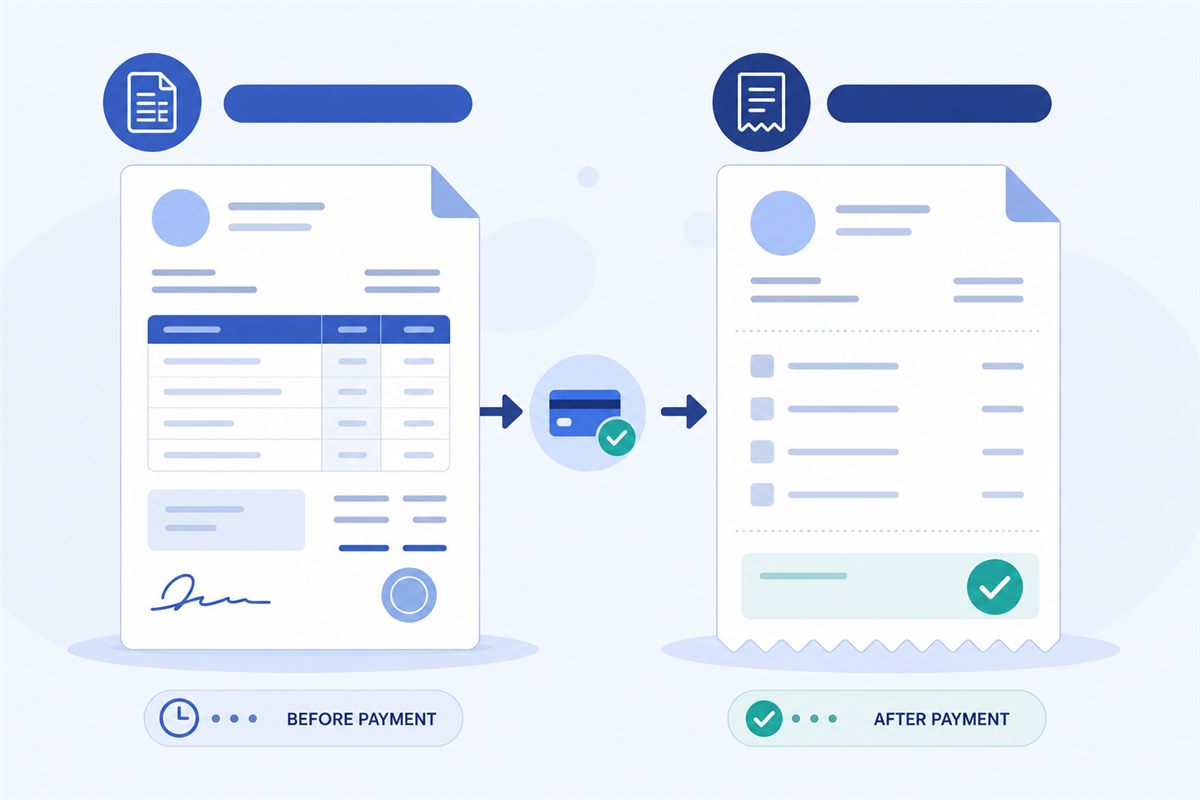
The main difference between an invoice and a receipt comes down to timing and purpose. An invoice is a formal request for payment — issued before payment is received. A receipt is a proof of payment — issued after payment has been received. Understanding when to use each, what each must include, and how invoices and receipts serve different roles in your business is essential for every freelancer and small business owner.
Quick Answer — Invoice vs Receipt:
- Invoice = A formal request for payment BEFORE money is received
- Receipt = Proof of payment AFTER money has been received
- Both are important documents — but they serve completely different purposes
- Freelancers need both — invoice to bill clients, receipt to confirm payment
- For tax purposes, receipts serve as proof of purchase; invoices record sales transactions
What is an Invoice? — A Formal Request for Payment
An invoice is a document that a seller or freelancer sends to a customer to request payment for goods or services delivered. It is issued before payment is made and serves as a formal, legally recognized request for payment that outlines exactly what was delivered, how much is owed, and when payment is due.
Think of an invoice as a formal request — it says: "I have delivered what we agreed upon. Here are the details. Please pay by this date." The invoice initiates the payment process and creates a legal record of the transaction between buyer and seller. Other invoice types, such as a proforma invoice, are used before the final bill.
What Must an Invoice Include?
A professional invoice must contain these essential elements:
- Your business name and address
- Client's name and address
- Unique invoice number — for tracking and accounting
- Invoice date — when it was issued
- Due date — when payment must be received
- Detailed description of goods or services provided
- Quantity and unit price for each line item
- Total amount due — clearly stated
- Payment terms — Net 15, Net 30, Due on Receipt
- Payment method details — bank account, Payoneer, Wise
- Sales tax amount — if applicable
For Pakistani freelancers, a complete invoice should also include your NTN (National Tax Number) and STRN if you are GST-registered. This makes the invoice compliant with FBR requirements and allows your client to claim input tax credit. See our full guide on what an invoice should include.
What is a Receipt? — Proof That Payment Has Been Received
A receipt is a document issued after payment has been completed. It serves as proof that a customer has paid for goods or services — confirming that the transaction is complete and the obligation has been fulfilled. A receipt confirms payment — it does not request it.
A receipt is essentially payment confirmation — it says: "We have received your payment. Here is your proof of purchase." Receipts are critical for tax purposes, expense tracking, returns and refunds, and accounting records on both sides of the transaction.
What Must a Receipt Include?
- Receipt number — unique identifier
- Date payment was received — not the invoice date
- Seller's business name and contact details
- Buyer's name
- Description of goods or services paid for
- Amount paid — exact figure
- Payment method used — cash, bank transfer, card
- Any tax collected — sales tax or GST
Invoice vs Receipt — Complete Comparison
Here is the complete side-by-side comparison of the key differences between an invoice and a receipt:
| Feature | Invoice | Receipt |
|---|---|---|
| Purpose | Request for payment — formal demand for money owed | Proof of payment — confirmation money was received |
| Timing | Issued BEFORE payment is received | Issued AFTER payment has been received |
| Who Issues It | Seller / Freelancer / Service Provider | Seller / Freelancer after receiving payment |
| What It Confirms | Amount owed and payment due date | Payment has been completed successfully |
| Legal Role | Creates a payment obligation for the buyer | Serves as proof of purchase for the buyer |
| For Accounting | Records accounts receivable — money owed to you | Records completed transaction — income received |
| For Tax Purposes | Documents sales and services for tax filing | Serves as proof of purchase for tax deductions |
| Includes Due Date? | Yes — essential element of every invoice | No — payment already done, no due date needed |
| Includes Payment Method? | Yes — tells client how to pay you | Yes — records how payment was actually made |
| Can Be Used For Returns? | No — invoice does not confirm payment | Yes — receipts are required for returns and refunds |
When to Use an Invoice and When to Use a Receipt
Use an Invoice When:
- You have completed a project and need to bill your client
- You want to formally request payment with a specific due date
- You are providing goods or services on credit or payment terms
- You need a legal record of the amount owed for accounting purposes
- Your client requires documentation before processing payment through their finance department
Use a Receipt When:
- A client has paid you and needs written confirmation of payment
- A customer pays in cash at point of sale and needs proof of purchase
- You receive payment for goods or services and want to confirm the transaction is complete
- Your client needs proof of payment for their accounting and tax deductions
- You want to protect yourself legally by documenting that payment was received
Real-World Example for Pakistani Freelancers:
You complete a logo design project for a client in Karachi
- Step 1: You send an INVOICE → "Logo Design — PKR 25,000 — Due in 15 days"
- Client reviews the invoice and processes payment through their bank
- Step 2: Payment arrives in your account
- Step 3: You send a RECEIPT → "Received PKR 25,000 on July 10, 2026 via bank transfer"
- Now both parties have documentation — you have proof of the sale, client has proof of purchase
Do Freelancers Need Both an Invoice and a Receipt?
Yes — and understanding why invoices and receipts are crucial for your freelance business is important. Each document serves a different purpose in the transaction lifecycle, and maintaining both creates a complete financial paper trail. For the full workflow, see our invoicing guide for self-employed freelancers.
An invoice initiates the payment process — without it, clients have no formal basis for processing your payment through their accounting systems. Many corporate clients cannot pay without a proper invoice — their finance departments require it for procurement approval.
A receipt closes the transaction — it gives the client proof of purchase for their expense records and confirms to both parties that the payment process is complete. For tax purposes, receipts are essential — they serve as evidence of business transactions when filing income tax returns.
Invoice vs Receipt in Accounting and Tax Records
From an accounting perspective, invoices and receipts play very different roles in maintaining accurate financial records:
Invoices in Accounting:
- Recorded as accounts receivable — money that is owed to your business
- Used to track outstanding payments and follow up on overdue amounts
- Form the basis of your sales records for income tax filing
- Required for GST/sales tax reporting if you are registered with FBR
Receipts in Accounting:
- Recorded as completed income — money that has been received
- Used to reconcile your bank statements with your invoice records
- Serve as proof of purchase for business expenses and tax deductions
- Essential documentation during tax audits — proof that transactions occurred
| Accounting Term | Invoice | Receipt |
|---|---|---|
| Records | Accounts Receivable | Cash / Bank Inflow |
| Stage | Pre-payment — obligation created | Post-payment — obligation settled |
| Tax Filing | Documents sales income | Proves expenses for deductions |
| Cash Flow Impact | Expected future income | Actual income received |
| Audit Trail | Shows what was billed | Shows what was paid |
Digital Invoices and Receipts — The Modern Approach
In 2026, most freelancers and small businesses send both invoices and receipts digitally — as PDF documents via email. Tools like Adobe Acrobat, online invoice generators, and payment platforms like Stripe and SumUp generate professional digital receipts automatically when payment is processed.
For Pakistani freelancers, using a free online invoice tool to create an invoice and send it as a PDF is the most professional and efficient approach. Once payment is confirmed, you can create a receipt using the same tool — keeping both documents consistent and professionally formatted.
An electronic signature can be added to both invoices and receipts to increase their legal standing — especially for larger transactions where formal documentation is important for both parties.
Common Mistakes Freelancers Make with Invoices and Receipts
- Sending a receipt instead of an invoice — a receipt confirms payment received; if you send it before payment, clients get confused about whether they've already paid.
- Never issuing receipts — many freelancers send invoices but never follow up with a receipt once paid. This leaves clients without proof of purchase for their tax deductions.
- Using the same document number for invoices and receipts — keep your invoice numbers and receipt numbers in separate sequences to avoid accounting confusion.
- Missing due dates on invoices — an invoice without a specific due date is a weak payment request. Always include an exact date: "Due by July 25, 2026". Learn more in our payment terms guide.
- Not keeping copies — both invoices and receipts should be saved in your records for at least 5 years for tax purposes and potential disputes.
- Confusing invoice date with receipt date — the invoice date is when you billed the client; the receipt date is when you received payment. These are almost always different dates.
For more pitfalls to avoid, read our guide on 7 common invoice mistakes freelancers make.
Invoice vs Receipt in Pakistan — What Freelancers Need to Know
For Pakistani freelancers and business owners, both documents have specific relevance under FBR regulations:
Pakistani Tax Context — Invoice vs Receipt:
- GST-registered businesses must issue a proper TAX INVOICE (not just a receipt) to allow buyers to claim input tax credit
- For international clients: always issue an invoice — exports of services are zero-rated, so no GST applies
- For local clients: issue an invoice with correct NTN and STRN if GST-registered
- Receipts are important for your own expense tracking and NTN filer status documentation
- Keep all invoices and receipts for minimum 5 years — FBR can audit past records
- Sales tax invoices must meet FBR's specific requirements under Sales Tax Act 1990
See the full breakdown in our FBR Invoice Format Pakistan — NTN, STRN & GST Requirements guide.
Create Professional Invoices and Receipts for Free
You do not need expensive invoicing software to create an invoice or send a receipt professionally. Unique Invoice Generator is a completely free online invoice tool — no signup required — that lets you create professional PDF invoices in under two minutes. Once your client pays, you can create a receipt using the same tool to complete the transaction documentation.
- Create invoices with NTN and STRN for FBR compliance
- Add detailed description of goods or services
- Set payment terms — Net 15, Net 30, Due on Receipt
- Include your preferred payment method details
- Download as PDF — send via email instantly
- Free to use — no account, no watermark
Create your free professional invoice now
No signup required. Download a PDF invoice in under two minutes.
Create Invoice Free →Frequently Asked Questions
What is the main difference between an invoice and a receipt?
The main difference between an invoice and a receipt is timing and purpose. An invoice is a formal request for payment issued before payment is received — it tells the client what they owe and when it is due. A receipt is proof of payment issued after payment has been received — it confirms the transaction is complete and serves as proof of purchase.
Can an invoice serve as a receipt?
No — an invoice and a receipt are two separate documents with different purposes. An invoice requests payment and creates a payment obligation. A receipt confirms payment and serves as proof of purchase. Using an invoice as a receipt — or vice versa — creates confusion in accounting records and can cause problems during tax audits. Always issue both: an invoice to bill the client, and a receipt once payment is received.
Do freelancers need to issue receipts in Pakistan?
While receipts are not legally mandatory for every freelance transaction in Pakistan, they are strongly recommended. Issuing a receipt after payment is received gives your client proof of payment for their expense records and tax deductions. It also protects you legally by documenting that payment was received. For GST-registered freelancers, issuing proper sales tax invoices and corresponding receipts is required under FBR regulations.
When should I send an invoice vs a receipt?
Send an invoice immediately after completing and delivering your work — within 24 hours if possible. This initiates the payment process and sets clear expectations for the due date. Send a receipt once the client's payment has been received in your account — this closes the transaction and gives the client their proof of purchase. Never send a receipt before payment arrives.
What is the difference between an invoice and a receipt for tax purposes?
For tax purposes, an invoice documents your sales and income — it is used to report revenue to tax authorities. A receipt serves as proof of purchase for business expenses — it is used to claim tax deductions on costs your business incurred. In Pakistan, FBR requires GST-registered businesses to maintain proper invoice records for sales tax reporting, while receipts support expense claims and accounting reconciliation.
Is a receipt issued before or after payment?
A receipt is always issued after payment has been received — never before. This is the fundamental difference that distinguishes a receipt from an invoice. An invoice is issued before payment as a request for payment. A receipt is issued after payment as payment confirmation. Issuing a receipt before payment is received would be incorrect and misleading.
What happens if I don't issue invoices or receipts?
Without proper invoices, you have no formal record of what clients owe you — making it difficult to follow up on unpaid amounts and creating cash flow problems. Without receipts, clients have no proof of purchase for their expense claims, and you have no documented evidence that payment was received. Both gaps create problems during tax audits and financial disputes. Using a free online invoice tool to maintain both documents is the simplest solution.
Final Thoughts
Understanding the key differences between an invoice and a receipt is fundamental to running a professional freelance business. An invoice is a document that requests payment before money is received — it creates the payment obligation. A receipt serves as proof that payment has been received — it closes the transaction.
Both documents are essential. Use invoices to bill clients professionally, track accounts receivable and maintain cash flow. Use receipts to confirm completed payments, give clients proof of purchase, and build a complete financial record for tax purposes.
Ready to create professional invoices and receipts?
Try Unique Invoice Generator — completely free, no signup required. Create invoices and receipts in under two minutes.
Create Invoice Free →