Freelancer Tax in Pakistan (2026): The Complete Guide to NTN, PSEB & the 0.25% Rate
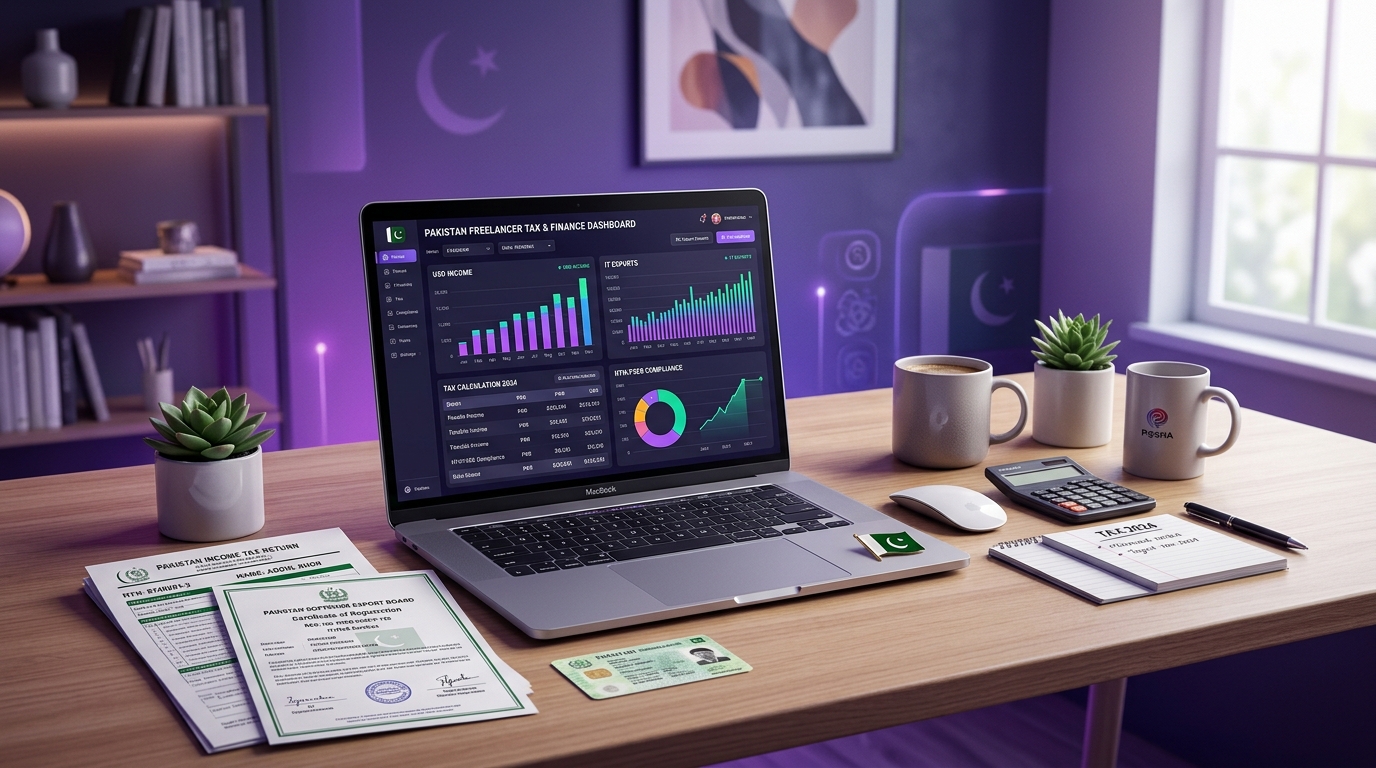
If you earn money as a freelancer in Pakistan, one question matters more than most: how much tax do you owe, and what do you need to do to stay on the right side of the FBR? The answer depends on who pays you, how the money reaches you, and whether you are registered with the Pakistan Software Export Board (PSEB).
This complete guide to freelancer tax in Pakistan explains the 0.25% final tax rate for PSEB-registered IT freelancers (now extended to June 30, 2029), how the 1% default and the normal income tax slabs work, how to get your NTN, how to file your tax return on the FBR IRIS portal, and how to keep the invoices and bank records that back up every rupee you declare.
Rates and deadlines change with each Finance Act, so everything here reflects the rules as of October 2026. Treat it as general information, not tax advice (see the disclaimer at the end).
Quick Answer: Freelancer Tax in Pakistan
- Yes, freelance income is taxable in Pakistan. That includes money from foreign clients, Upwork, and Fiverr.
- 0.25% final tax applies if you are registered with PSEB and your qualifying IT or IT-enabled export income reaches you through an approved bank. Budget 2026-27 extended this rate to June 30, 2029.
- 1% is the default rate on export proceeds if you are not registered with PSEB.
- Clients inside Pakistan: income falls under the normal non-salaried income tax slabs.
- You still need an NTN and should file an annual return, even when tax was already deducted at source by your bank.
Do Freelancers Have to Pay Tax in Pakistan?
Yes. The Federal Board of Revenue (FBR) treats you as a self-employed taxpayer if you provide services independently rather than under a salaried employment contract. That covers developers, designers, writers, marketers, virtual assistants, translators, and consultants, whether your clients are in Karachi or California.
Both local and foreign earnings count as taxable income. Money you receive from Upwork, Fiverr, Payoneer, or a direct client abroad is taxable once it reaches your Pakistani bank account, and the bank may deduct tax at source. That deduction does not mean the income stays out of your tax return — you still declare it annually.
Is freelance income tax-free in Pakistan?
No. You may have seen claims online that IT freelancers pay zero tax. Those usually refer to Section 65F of the Income Tax Ordinance, 2001, an older and conditional tax credit exemption for IT exporters that was time-limited (reported as valid through June 2026) and came with strict conditions. For realistic planning and compliance, most freelancers should assume the 0.25% final tax rate, not 0%.
Is there a minimum income for paying tax?
For individuals, the first Rs 600,000 of annual taxable income is exempt under the normal slabs. Many freelancers who earn less still file an annual return, because staying on the FBR’s Active Taxpayer List (ATL) brings substantial financial benefits, which we cover in detail below.
Freelancer Tax Rate in Pakistan 2026: 0.25% vs 1% vs Normal Slabs
Which tax rate applies depends on three factors: who your client is, whether you are registered with PSEB, and how the payment reaches you. The table below breaks down the main scenarios:
| Your Situation | Tax Treatment | What You Need to Know |
|---|---|---|
| PSEB-registered, qualifying IT or IT-enabled export income received through a Pakistani bank | 0.25% final tax on gross export receipts (Section 154A) | The bank withholds it when the money arrives. No further income tax on this income if all conditions are met. |
| Not registered with PSEB, export income received through a bank | 1% withheld by the bank | Four times the PSEB rate. Ask a tax professional whether the 1% is treated as final or adjustable in your specific case. |
| Clients inside Pakistan | Normal income tax slabs | First Rs 600,000 exempt; top rate reaches 45% for non-salaried individuals. Documented business expenses can be deducted. |
| Foreign income not routed through approved banking channels, or below the 80% rule | You risk losing the concessional rate | Subject to ordinary non-salaried slabs. See the 80% rule below. |
Budget 2026-27 Update
The 0.25% Final Tax Regime (FTR) was due to expire on June 30, 2026. In the budget presented on June 12, 2026, the government extended it for three more years, to June 30, 2029 (as reported by Business Recorder).
The Finance Act 2026 also cut the advance tax on foreign-currency card transactions from 5% to 0.5% effective July 1, 2026, which substantially lowers costs if you pay for software licenses, cloud servers, AI tools, or digital ads using a debit/credit card.
Because the 0.25% is calculated on gross export receipts, your business expenses do not change the amount of tax on that income. That keeps tax computation straightforward, but it also means the tax planning that matters is about timely registration, banking channels, and documentation, not deductions.
Which Freelancers Qualify for the 0.25% Rate?
The reduced 0.25% tax rate is not automatic. Four mandatory conditions must be satisfied, and missing even one can cost you the concession:
- Qualifying services: The income must come from exporting computer software, IT services, or IT-enabled services (ITeS). Software and web development clearly fit. For services such as graphic design, content writing, or digital marketing, verify PSEB’s classification list before assuming your service is covered.
- An active PSEB registration: You must hold a valid PSEB certificate and renew it every year on time.
- Banking channels and the 80% rule: The foreign exchange proceeds must be received in Pakistan through approved banking channels, and at least 80% of your foreign income for the tax year should arrive that way.
- Proof and compliance: Obtain and retain the Proceeds Realization Certificate (PRC) or bank credit advice for each incoming remittance, and file your annual tax return so you maintain active filer status on the ATL.
The 80% rule in plain English
Suppose you bill foreign clients $12,000 in a tax year. To meet the 80% rule, at least $9,600 of that must reach Pakistan through an authorized bank. If you leave $4,000 in a foreign digital account or wallet and bring in only $8,000 (about 67%), you fall below the mandatory threshold and risk losing the concessional treatment on your entire export earnings. Track this ratio across the whole tax year, not invoice by invoice.
What is a Proceeds Realization Certificate (PRC)?
A Proceeds Realization Certificate (PRC) is a bank-issued legal document proving that foreign currency was received from abroad and converted into Pakistani Rupees through approved banking channels. It typically carries a State Bank export purpose code that classifies your service category.
Ask your bank branch or use internet banking to request a PRC for every foreign remittance credited to your account, and save them in a dedicated folder. Without PRCs, proving to the FBR that your income qualifies as tax-concessional export income is substantially harder.
What counts as export income?
Export income is payment for services you deliver to clients outside Pakistan, received in foreign currency into your Pakistani bank account. Payments from clients located inside Pakistan are legally treated as domestic income and are subject to the normal income tax slabs.
PSEB Registration for Freelancers: Step by Step
The Pakistan Software Export Board (PSEB) is the apex government body that registers IT and IT-enabled services exporters. For a freelancer, PSEB registration is the single step that drops your withholding tax rate from 1% down to 0.25%.
- Get your NTN first: An individual freelancer needs a valid CNIC and an active individual NTN before applying.
- Create an account on the PSEB portal: Visit the official PSEB portal at pseb.org.pk (or its Tech Destination portal) and begin the online freelancer registration.
- Enter your details: Provide your CNIC, service classification, contact information, and bank account details. Upload evidence proving you export IT services (e.g., Upwork/Fiverr profile links, client contracts, or recent invoices).
- Wait for approval and download your certificate: After PSEB verifies your documents, download your official registration certificate.
- Submit the certificate to your bank: Hand over or email a copy of the certificate to your bank branch manager or foreign remittance department so they tag your account for 0.25% withholding instead of 1%.
- Renew annually: Keep your registration current every year and file your annual tax return on time.
Two Practical Warnings for Freelancers
- PSEB registration is not a one-time job: It is valid for one year. Some banks automatically revert to deducting 1% the day your certificate expires. Put a calendar reminder 30 days before renewal.
- Check your bank credit advice: Some freelancers find their bank branch continues deducting 1% even after receiving the certificate. Inspect the withholding amount on your first few remittances and immediately follow up with your branch if the deduction is higher than 0.25%.
NTN Registration and Filer Status (ATL)
Your National Tax Number (NTN) is your primary tax identity with the FBR. For individuals, your NTN is linked directly to your 13-digit Computerized National Identity Card (CNIC) number.
You can register free online through the FBR IRIS portal (iris.fbr.gov.pk) using the voluntary individual registration form, or visit your nearest Regional Tax Office (RTO). Have your CNIC, mobile phone registered in your name, and email address ready.
Do I need to register a business to get an NTN?
No. An individual freelancer can register simply as an individual (a sole proprietor) and does not need a registered company to get an NTN. Incorporating a private limited company with the Securities and Exchange Commission of Pakistan (SECP) is a separate, optional step that some freelancers take later when hiring employees or signing enterprise contracts.
What is the Active Taxpayer List (ATL)?
The Active Taxpayer List (ATL) is the FBR’s public database of individuals and companies who filed their annual income tax return for the latest tax year. Maintaining active filer status provides significant real-world savings:
- Substantially lower withholding tax on bank cash withdrawals and profit on debt.
- 50% to 100% lower advance tax on motor vehicle registration, token tax, and property transfers.
- Maintains your eligibility for PSEB renewal and export concession regimes.
- Provides verifiable proof of legal income for credit cards, home loans, and international travel visas.
Tax on Fiverr and Upwork Income in Pakistan
Platform earnings are treated as foreign export income under Pakistani tax regulations. Here is how funds flow from international clients to your local account and where tax deductions occur:
Client pays the platform: The foreign client pays Upwork or Fiverr, and the marketplace deducts its commission (e.g., 10%–20%).
You withdraw funds: You transfer the balance directly to a Pakistani bank account, or via Payoneer or Wise to your local account. State Bank foreign exchange rules recognize these routes as approved banking channels when funds terminate in a Pakistani bank account.
Bank withholds tax: When the remittance hits your Pakistani bank account, the bank withholds tax at source: 0.25% if you have an active PSEB certificate on file, or 1% if unregistered. The bank generates a credit advice and PRC.
Annual filing: When filing your annual tax return on IRIS, declare your gross export proceeds and claim the exact withholding tax already deducted by your bank.
Keep your platform earnings summaries alongside your bank statements. Your bank withholds tax on the exact amount credited to Pakistan; marketplace service fees deducted prior to withdrawal are not seen by the bank. Consult a tax professional on reporting gross earnings versus net remittance amounts in your return.
Banks convert US dollars to PKR using their own interbank or remittance rate. If you need a benchmark rate when preparing your accounts, reference State Bank of Pakistan (SBP) weighted average exchange-rate tables, but always reconcile with your bank's credit advice.
Local Clients vs Foreign Clients: Income Tax Slabs and Provincial Sales Tax
Income from clients inside Pakistan
If your clients are based inside Pakistan, the 0.25% concessional export regime does not apply. Your domestic freelance earnings fall under the normal income tax slabs for non-salaried individuals. The first Rs 600,000 per year is tax-free, progressive rates apply above that, and the top bracket reaches 45%.
Unlike export income taxed under the 0.25% Final Tax Regime, you can deduct legitimate business expenses from your local revenue. Deductible expenses include high-speed internet, coworking space memberships, software subscriptions, office supplies, and equipment depreciation (such as a laptop, workstation, or phone). Keep clean digital invoices and receipts for every claimed expense.
Do freelancers pay sales tax?
Federal sales tax, governed by the FBR under the Sales Tax Act 1990 and linked to an STRN, primarily covers physical goods. Following the 18th Constitutional Amendment, sales tax on services is collected by provincial revenue bodies:
- Sindh Revenue Board (SRB) — Services rendered in Sindh
- Punjab Revenue Authority (PRA) — Services rendered in Punjab
- Khyber Pakhtunkhwa Revenue Authority (KPRA) — Services rendered in KPK
- Balochistan Revenue Authority (BRA) — Services rendered in Balochistan
Whether you must register for provincial sales tax depends on your province of residence, service type, and annual revenue. IT service exports are generally exempt or zero-rated, but provincial rules can adjust with annual Finance Acts. For detailed invoice formatting guidelines, explore our guides on FBR invoice format, NTN and STRN requirements, and how to create a GST invoice in Pakistan.
How to File Your Income Tax Return on the FBR IRIS Portal
Documents to gather before filing
- Your CNIC and FBR IRIS login credentials (NTN & password)
- Valid PSEB registration certificate (if registered)
- Bank statements for all accounts covering July 1 through June 30 of the tax year
- Proceeds Realization Certificates (PRCs) and bank withholding certificates for every remittance
- Platform earnings records (Upwork, Fiverr, Payoneer, Wise)
- Copies of client invoices and service contracts
- Business expense receipts and rent/utility bills (for domestic income)
Steps to file on IRIS
- Log in to IRIS: Access iris.fbr.gov.pk with your NTN / CNIC and password.
- Open the tax return: Select Declaration > Returns / Statements (Normal Returns) and select the applicable tax year (e.g., Tax Year 2026 covers income earned from July 1, 2025 to June 30, 2026).
- Declare your income: Enter export receipts under the final tax section (Section 154A / Export of Computer Software or IT Enabled Services). If you have domestic earnings, enter them under the business or normal income tabs.
- Enter tax withheld: Input the tax already deducted by your bank into the adjustable / final tax withholding tab using your bank deduction certificates.
- Complete the wealth statement: Disclose your assets, bank balances as of June 30, personal expenditures, and net wealth reconciliation.
- Review and submit: Verify all figures, enter your 4-digit verification PIN, submit the return, and download the official acknowledgment receipt.
If your return includes mixed foreign and local revenue, multiple properties, capital assets, or international investments, working with a qualified tax practitioner or Chartered Accountant can save time and prevent audit notices.
What is the tax return deadline for freelancers?
The statutory due date for individuals in Pakistan is September 30 following the end of the tax year on June 30. The FBR frequently grants extensions; for Tax Year 2026, the deadline was extended first to October 15 and then to October 31, 2026. Always confirm with the latest official FBR notifications.
Do I still need to file if tax was already deducted?
Yes, absolutely. Bank withholding is merely a collection mechanism. You must file an annual income tax return on IRIS to reconcile that deduction, maintain your active filer status on the ATL, and safeguard your PSEB compliance.
What happens if a freelancer does not file?
If you fail to file, the FBR removes your name from the Active Taxpayer List. As a non-filer, you face double withholding taxes on bank transactions, property, and vehicle registrations, risk statutory late-filing fines, and jeopardize your PSEB certificate standing. In addition, you lose the ability to provide formal tax returns as proof of income for bank accounts, business financing, or foreign visa applications.
How to Invoice Correctly for Tax (NTN, Currency and Records)
Accurate, compliant invoices are the backbone of a defensible tax file. They establish the direct connection between three things the FBR, SBP, and your commercial bank audit:
- The professional service you delivered
- The foreign currency received
- The official bank remittance documentation (PRC)
A professional freelance invoice in Pakistan must include:
- Your legal name or registered trade name, address, and NTN
- The client’s company name, country, and overseas business/tax ID where applicable
- A unique sequential invoice number and invoice date
- A detailed description of the IT or digital services provided
- The amount and currency (USD, GBP, EUR, or PKR), showing zero sales tax on foreign exports
- Payment terms, IBAN / SWIFT details, or platform withdrawal identifiers
Keep the full audit chain unbroken: Client Invoice → Incoming Bank Payment → Bank Credit Advice / PRC → Accounting Ledger → Annual Tax Return. When every bank deposit matches a numbered invoice and PRC, responding to any tax inquiry is straightforward.
If you bill international clients, review our dedicated guide on how to invoice international clients from Pakistan. If you need a ready-to-use template, our free invoice template for freelancers in Pakistan provides a clean layout, while our invoice generator Pakistan enables you to generate custom PKR or USD invoices with NTN and STRN fields in under two minutes.
Freelancer Tax Calculator Pakistan: Worked Example (0.25% vs 1%)
Estimating tax on freelance export income is simple. Multiply your gross export receipts by the applicable withholding rate:
| Annual Export Receipts | PSEB-Registered (0.25%) | Not Registered (1%) | You Save with PSEB |
|---|---|---|---|
| Rs 1,000,000 | Rs 2,500 | Rs 10,000 | Rs 7,500 |
| Rs 3,000,000 | Rs 7,500 | Rs 30,000 | Rs 22,500 |
| Rs 5,000,000 | Rs 12,500 | Rs 50,000 | Rs 37,500 |
| Rs 10,000,000 | Rs 25,000 | Rs 100,000 | Rs 75,000 |
In every row, the tax is assessed on gross export receipts, not net profit. The final column demonstrates that PSEB registration pays for itself multiple times over. These numbers assume the income qualifies as IT/ITeS export proceeds remitted through banking channels. For income from domestic Pakistani clients, use the current FBR non-salaried tax slabs and deduct allowable expenses first.
Common Tax Mistakes Freelancers Make
- Not registering with PSEB: Leaving money on the table by paying 1% instead of 0.25%.
- Keeping excessive foreign currency abroad: Stashing earnings in offshore wallets and violating the 80% remittance rule.
- Failing to collect PRCs: Forgetting to obtain a Proceeds Realization Certificate from your bank for every incoming transfer.
- Skipping the annual return: Assuming that automatic bank withholding excuses you from filing an FBR return.
- Letting PSEB registration lapse: Failing to renew before expiry, causing banks to revert your deduction rate to 1%.
- Not checking remittance deductions: Not confirming whether your bank actually applied 0.25% after receiving your certificate.
- Mixing personal and business expenses: Using a single personal bank account for family expenses and business receipts, making audits difficult.
- Relying on outdated 0% exemption articles: Following obsolete tax advice written prior to recent Finance Acts and Budget 2026-27 updates.
Frequently Asked Questions About Freelancer Tax in Pakistan
Yes. Income from local and foreign clients is taxable. For PSEB-registered IT freelancers, qualifying export income received through a bank is taxed at 0.25%. Other income follows the rates described above.
For PSEB-registered freelancers whose income meets all the conditions, the tax withheld under Section 154A is treated as final tax on that income, so it is not taxed again under the normal slabs. You should still file an annual return.
The bank withholds 1% instead of 0.25%. On $10,000, that is $100 instead of $25. Ask a tax professional whether the 1% is final or adjustable for your situation.
You do not need it to work as a freelancer, but it is what unlocks the 0.25% rate. Without it, the default rate on export proceeds is 1%.
On export income taxed at 0.25% as a final tax on gross receipts, expenses do not reduce the tax. On income from local clients, which falls under the normal slabs, genuine business expenses can be deducted. Keep receipts for both.
Not automatically. The 0.25% regime is for IT and IT-enabled services export income. The Finance Act 2026 introduced separate withholding rules for income from social media platforms, reported as a 5% deduction from July 1, 2026. Creators should check their position with a tax professional.
Not always. Many freelancers with one regime, bank-withheld tax and a few clients file on IRIS themselves. Get professional help if you have mixed local and foreign income, large amounts, expenses to claim, or you are unsure about the 80% rule.
Final Thoughts
Freelancer tax in Pakistan comes down to four fundamental habits: register with PSEB if you qualify, route your foreign earnings through banking channels, maintain your PRCs and invoices, and file your return every year. With the 0.25% rate extended to June 2029, the regulatory environment is more predictable than it has been in years — but the savings only benefit freelancers who keep their documentation in order.
Create Your Next Freelance Invoice for Free
Add your NTN, select PKR or USD, add zero-rated sales tax for international clients, and download a professional PDF in minutes with Unique Invoice Generator. No signup required.
Create Free Invoice →Sources and Further Reading:
- Business Recorder: IT Exporters and Freelancers Welcome Extension of 0.25% Final Tax Regime
- Federal Board of Revenue (FBR) IRIS Portal
- Pakistan Software Export Board (PSEB) Official Portal
- Income Tax Ordinance, 2001 (Section 154A) & Finance Act 2026
Disclaimer: This article is general informational material based on publicly available rules and tax updates as of October 2026. It does not constitute legal or tax advice. Tax rates, thresholds, and filing deadlines change with each Finance Act, and your personal circumstances may differ. Always confirm specific requirements with the FBR, PSEB, your authorized bank, or a licensed tax professional before taking action.
Reviewed for compliance and E-E-A-T accuracy.